The 5-7-9 Squirrel Baffle Rule, Songbird Seed Chart & Optics Guide
Place pole baffles beyond squirrel jump physics, skip cheap millet filler seed and choose steady 8x42 backyard birding optics.
Most squirrel raids happen because of feeder placement rather than feeder failure. Eastern gray and fox squirrels are exceptional jumpers, so combining simple 5-7-9 clearance spacing with weight-activated hardware and targeted seed keeps backyard feeders stocked for songbirds.
Applying the 5-7-9 squirrel baffle spacing rule
Before hanging a feeder from the nearest tree limb, measure three clearances around a freestanding metal pole:
- 5 feet vertical clearance: Mount a smooth metal or wrap-around torpedo baffle so its top edge sits 4.5 to 5 feet above the ground. Squirrels routinely leap 4 feet straight up from grass or snowpack, so mounting a baffle at waist height lets them jump cleanly past it.
- 7 to 9+ feet horizontal clearance: Keep the pole at least 8 to 10 feet away from deck railings, fence posts, patio roofs and tree trunks. Gray squirrels comfortably clear 7 to 8 feet horizontally from elevated launch points.
- 10 to 12 feet overhead clearance: Avoid placing the pole directly under horizontal tree branches where squirrels can drop down onto the feeder roof.
Where yard space makes a freestanding pole impossible, pair a baffle with a weight-calibrated metal feeder whose ports shut automatically under squirrel weight. Compare trigger designs in our squirrel-proof bird feeder guide.
Matching US backyard songbirds to zero-waste seed
Cheap retail seed sacks pad weight with red millet, milo, oats and cracked corn that most desirable songbirds kick onto the ground, attracting rodents and starlings. Switch to targeted foods instead:
| Backyard Bird Group | Preferred Seed / Food | Best Feeder Hardware |
|---|---|---|
| Northern Cardinals & Grosbeaks | Black oil sunflower, safflower | Wide sturdy tray or weight-activated hopper |
| American Goldfinches & Siskins | Nyjer (thistle), sunflower hearts | Fine-mesh tube or upside-down finch ports |
| Woodpeckers & Nuthatches | No-melt suet cakes, shelled peanuts | Tail-prop suet cage or wire peanut cylinder |
| Bluebirds & Wrens | Dried or live mealworms | Open dish or 1.5-in caged mealworm feeder |
Test combinations for your yard and winter freezing zone in our free Backyard Bird Seed & Feeder Matcher.
Smart camera feeder and backyard optics checklist
If you plan to watch visitors remotely or up close, verify four hardware specifications before buying: - 2.4 GHz Wi-Fi signal reach: Almost all smart camera feeders connect exclusively on 2.4 GHz Wi-Fi (not 5 GHz). Check phone Wi-Fi bars at the exact pole location before mounting, see antenna and solar specs in our smart camera bird feeder comparison. - Subscription transparency: Check whether AI bird-species identification or cloud clips require an optional paid plan, or whether local microSD storage works free. - 8x42 binoculars with short close focus: For backyard viewing at 10 to 30 feet, verify close-focus distance (under 8 to 10 feet) and eye relief (15 mm+ if you wear eyeglasses) in our birding binoculars spec guide.
Backyard birding FAQ
What is the 5-7-9 rule for squirrel-proof bird feeders?
Place the top edge of a pole baffle at least 4.5 to 5 feet above ground, keep the feeder at least 7 to 9 feet (ideally 8 to 10 feet) horizontally from tree limbs, fences or deck rails, and avoid overhanging branches less than 10 to 12 feet above.
Which single seed attracts the most US backyard songbirds with minimal waste?
Black oil sunflower seed has thin shells and high fat content, drawing cardinals, chickadees, nuthatches, finches and woodpeckers while avoiding cheap red millet and milo fillers that scatter onto the lawn.
Do squirrels eat safflower seed?
Most eastern gray squirrels dislike the slightly bitter taste of safflower seed, while Northern Cardinals, chickadees, titmice and mourning doves eat it readily.
Why do experienced birders recommend 8x42 over 10x42 binoculars?
8x42 binoculars give a wider field of view (easier to track fast songbirds in trees), brighter image exit pupil in dawn shade and noticeably steadier hand-held viewing without tripod shake.
More birding guides
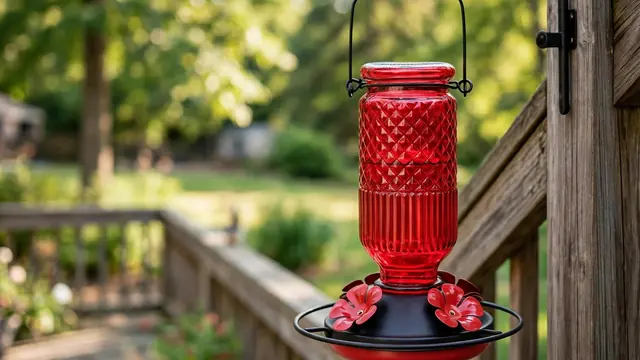 Squirrel-ProofBest Hummingbird Feeders 2026: 6 Top Backyard PicksWide-mouth glass bottles and dish-style saucer feeders compared by capacity, built-in ant moats, bee-guard ports, and routine maintenance.Read
 Squirrel-ProofBest Squirrel Proof Bird Feeder: 6 Top Picks for 2026Weight-activated shrouds and motorized spinning perches compared by seed capacity, port count, and cleaning design.Read
 Camera FeedersBest Smart Bird Feeder with Camera Picks (2026)Compare 6 smart bird feeders with solar panels, 4K and 2K resolution, AI bird recognition, and subscription-free storage.Read
 BinocularsBest Birding Binoculars: 7 Top Picks for 2026Compare 8x42 and 20x50 binoculars by magnification, field of view, prism coatings, waterproof seals, and tripod adaptability.Read